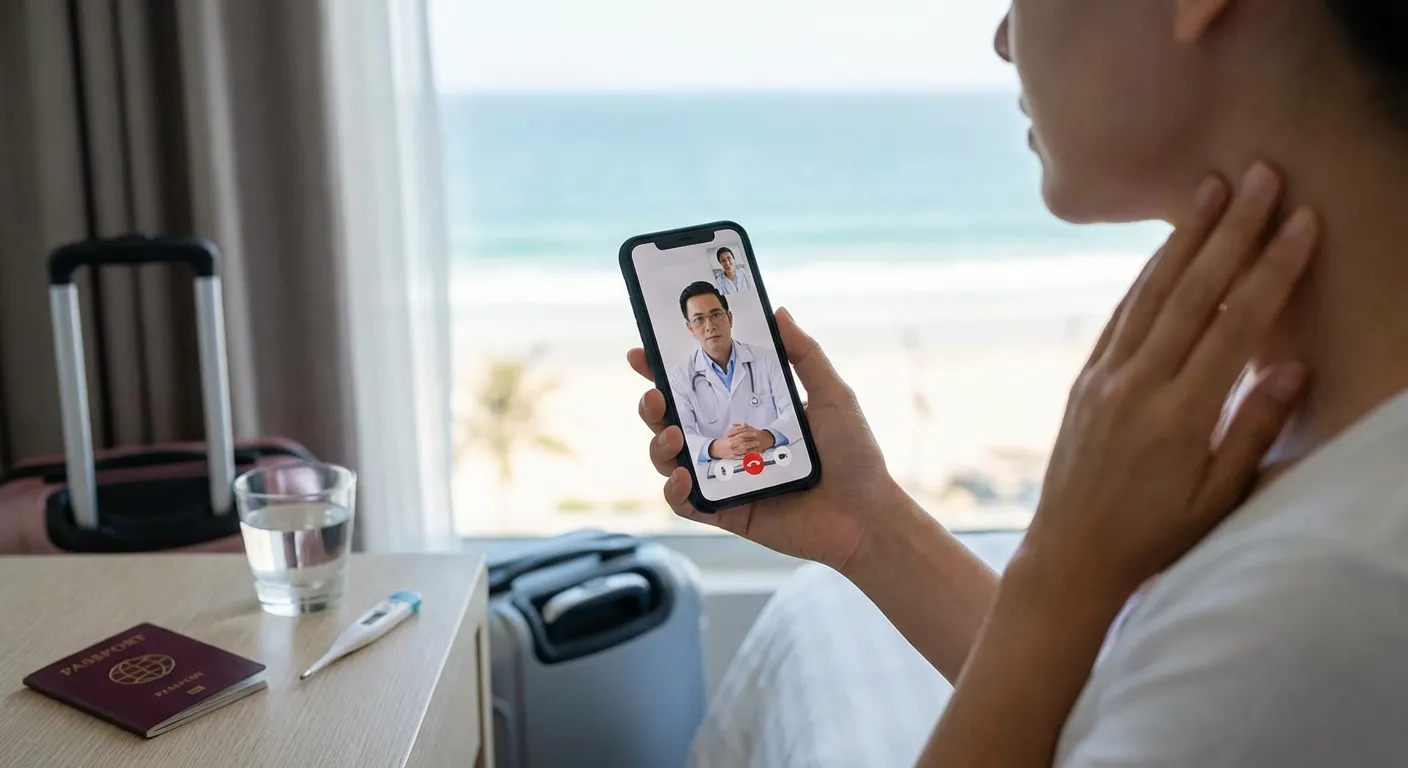
Ear Infection on Holiday: Antibiotic Ear Drops (2026)
Spanish pharmacies cannot sell drops with an antibiotic without a prescription. Speak with our doctors licensed in Spain by video consultation from €39.
Dr. Daniel Cuenca Leal
Colegiado nº 284627651 · Ilustre Colegio Oficial de Médicos de Madrid
Medically reviewed by Dr. Daniel Cuenca Leal · Updated October 27, 2026
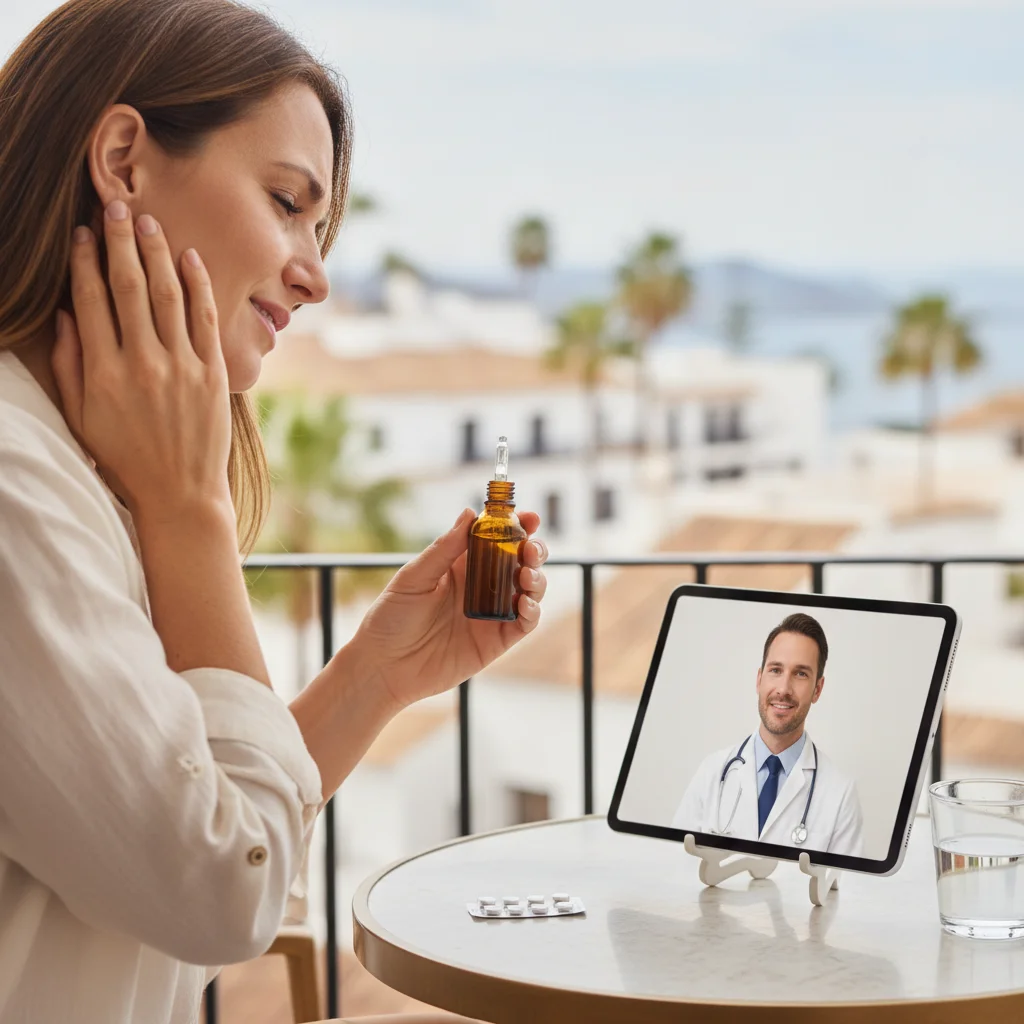
What should you do if you get an ear infection on holiday in Spain?
Quick answer: You cannot buy antibiotic ear drops over the counter in Spain because all 16 ear products containing antibiotics require a medical prescription. A Spanish pharmacy (farmacia) can sell you pain-relief ear drops or painkillers, but cannot dispense antibiotic drops without a prescription (receta). If you need an antibiotic, you must be evaluated by a doctor in person or via telemedicine who can issue a valid prescription.
UrgentDoc provides video consultations with English-speaking doctors licensed in Spain from EUR 39. You book a time that suits you. The doctor reviews your symptoms, medical history (including diabetes, a weakened immune system, ear tubes, ear surgery, or a previous perforated eardrum), current medicines, allergies, and whether you are pregnant or breastfeeding. You can see a doctor online about an antibiotic prescription to evaluate your symptoms and determine whether prescription treatment is appropriate.
This guide is provided for informational purposes only and does not replace professional medical advice, diagnosis, or treatment from a qualified healthcare provider.
Under European Commission rules, the European Health Insurance Card (EHIC) gives temporary visitors access to necessary public healthcare, but it does not cover private medical services [https://europa.eu/youreurope/citizens/health/unplanned-healthcare/temporary-stays/index_en.htm]. The table below outlines how healthcare routes in Spain compare for an ear infection:
| Route | Wait | What you pay | Language | What you can get |
|---|---|---|---|---|
| Pharmacy (farmacia), no appointment | None | Product price | Varies | Pain-relief ear drops and painkillers; no antibiotic ear drops |
| Public health centre (centro de salud) or hospital urgencias | Varies | EHIC: same rights as people insured in Spain, for care that can't wait | Varies | In-person ear examination; public prescription if the doctor decides |
| Private clinic | Varies | Clinic fee; the EHIC does not cover private care | Varies | In-person ear examination; private prescription if the doctor decides |
| UrgentDoc video consultation | A time you book | From EUR 39; medicine paid at the pharmacy | English | Video assessment without an ear examination; private prescription through REMPe if the doctor decides it is appropriate |
Can you buy antibiotic ear drops over the counter in Spain?
In Spain, every ear drop that contains an antibiotic, including every ciprofloxacin ear drop, needs a prescription. A pharmacy can sell you pain-relief ear drops and painkillers, but not antibiotic ear drops [https://cima.aemps.es/cima/publico/home.html]. Under Spanish pharmaceuticals legislation, medicines may be dispensed only by authorised pharmacies open to the public or hospital pharmacy services, and prescription-only medicines cannot be sold online or by mail order [https://www.boe.es/buscar/act.php?id=BOE-A-2015-8343]. Furthermore, Spain classifies each medicine product, not each ingredient, as prescription-only or non-prescription [https://cima.aemps.es/cima/publico/home.html].
According to the official database of the Spanish Agency of Medicines and Medical Devices (AEMPS), all 16 ear products on the Spanish market containing an antibiotic require a prescription [https://cima.aemps.es/cima/publico/home.html]:
| Product (Spanish name) | Active ingredients | What it is | Prescription in Spain? |
|---|---|---|---|
| Cetraxal Ótico, Aceoto, Septocipro Ótico, Otociprin Ótico, Ciprofloxacino Qualigen gotas óticas | ciprofloxacin | antibiotic ear drops | Yes |
| Cetraxal Plus, Aceoto Plus, Synalotic | ciprofloxacin + fluocinolone | antibiotic + corticosteroid drops | Yes |
| Ciproxina gotas óticas | ciprofloxacin + hydrocortisone | antibiotic + corticosteroid drops | Yes |
| Synalar Ótico | fluocinolone + neomycin + polymyxin B | antibiotic + corticosteroid drops | Yes |
| Otix | dexamethasone + polymyxin B + trimethoprim | antibiotic + corticosteroid drops | Yes |
| Neo-Hubber gotas | hydrocortisone + neomycin | antibiotic + corticosteroid drops | Yes |
| Colircusi Gentadexa | gentamicin + dexamethasone + tetryzoline | eye and ear drops with an antibiotic | Yes |
| Terracortril | hydrocortisone + oxytetracycline + polymyxin B | eye and ear ointment with antibiotics | Yes |
| Clotic | clotrimazole | antifungal ear drops | Yes |
| Ekzem | fluocinolone | corticosteroid ear drops | Yes |
| Menaderm Otológico | beclometasone + clioquinol | ear drops | Yes |
| Otogen Calmante | tetracaine + phenol + menthol + clove oil | pain-relief ear drops | No |
| Otocerum | turpentine oil + chlorobutanol + benzocaine + phenol + castor oil | earwax drops | No |
| Anticerumen Liade | sodium lauryl sulfate | - | No |
Every oral amoxicillin and oral ciprofloxacin tablet product marketed in Spain is also prescription-only [https://cima.aemps.es/cima/publico/home.html].
Swimmer's ear or middle ear infection: which one do you have?
Ear infections generally affect either the ear canal or the space behind the eardrum, and their medical management differs completely.
An outer-ear infection (otitis externa), often called swimmer's ear, is an inflammation of the external ear canal [https://www.saludcastillayleon.es/portalmedicamento/es/estrategias-programas/antimicrobianos/revision-guias-sacyl-pran-proa.ficheros/1482928-Otitis%20externa%20aguda.pdf]. Symptoms include ear discomfort, itching, discharge (otorrea), or reduced hearing [https://www.saludcastillayleon.es/portalmedicamento/es/estrategias-programas/antimicrobianos/revision-guias-sacyl-pran-proa.ficheros/1482928-Otitis%20externa%20aguda.pdf]. The most characteristic symptom is earache (otalgia) that intensifies when pressure is applied to the outside of the ear canal or earlobe [https://www.saludcastillayleon.es/portalmedicamento/es/estrategias-programas/antimicrobianos/revision-guias-sacyl-pran-proa.ficheros/1482928-Otitis%20externa%20aguda.pdf]. Risk factors include handling or manipulating the ear canal, changes in pH from bathing, eczema, and diabetes [https://www.saludcastillayleon.es/portalmedicamento/es/estrategias-programas/antimicrobianos/revision-guias-sacyl-pran-proa.ficheros/1482928-Otitis%20externa%20aguda.pdf]. Most cases are bacterial, though a significant proportion are fungal [https://www.saludcastillayleon.es/portalmedicamento/es/estrategias-programas/antimicrobianos/revision-guias-sacyl-pran-proa.ficheros/1482928-Otitis%20externa%20aguda.pdf].
An acute middle-ear infection (otitis media aguda) involves the space behind the eardrum (tímpano) [https://www.saludcastillayleon.es/portalmedicamento/es/estrategias-programas/antimicrobianos/revision-guias-sacyl-pran-proa.ficheros/1447736-Otitis%20media%20aguda%20%28en%20el%20adulto%29.pdf]. In adults, it is characterized by the sudden onset of ear pain and reduced hearing, with or without ear discharge or fever [https://www.saludcastillayleon.es/portalmedicamento/es/estrategias-programas/antimicrobianos/revision-guias-sacyl-pran-proa.ficheros/1447736-Otitis%20media%20aguda%20%28en%20el%20adulto%29.pdf]. In children, symptoms include ear pain (or irritability in young infants), discharge, reduced hearing, fever, and non-specific symptoms like vomiting or diarrhoea [https://resistenciaantibioticos.es/sites/default/files/2025-12/Infecciones%20del%20tracto%20respiratorio%20superior%20en%20pediatria.pdf].
Antibiotic ear drops are licensed for outer-ear infection (otitis externa); one combination is also licensed for middle-ear infection in people with ear tubes. When a middle-ear infection needs an antibiotic, Spanish guidance gives it by mouth, not as ear drops [https://cima.aemps.es/cima/dochtml/ft/60883/FT_60883.html] [https://cima.aemps.es/cima/dochtml/ft/64657/FT_64657.html] [https://www.saludcastillayleon.es/portalmedicamento/es/estrategias-programas/antimicrobianos/revision-guias-sacyl-pran-proa.ficheros/1447736-Otitis%20media%20aguda%20%28en%20el%20adulto%29.pdf] [https://resistenciaantibioticos.es/sites/default/files/2025-12/Infecciones%20del%20tracto%20respiratorio%20superior%20en%20pediatria.pdf]. Ciprofloxacin-only drops (Cetraxal Ótico) are licensed specifically for acute otitis externa [https://cima.aemps.es/cima/dochtml/ft/60883/FT_60883.html]. Ciprofloxacin combined with fluocinolone (Cetraxal Plus) is licensed for acute otitis externa and for acute middle-ear infection in patients who have tympanostomy tubes (grommets) [https://cima.aemps.es/cima/dochtml/ft/64657/FT_64657.html].
The condition of the eardrum determines which medicines are safe. For instance, ciprofloxacin combined with hydrocortisone (Ciproxina) is strictly contraindicated if the eardrum is or may be perforated, and the prescriber must confirm an intact eardrum before prescribing it [https://cima.aemps.es/cima/dochtml/ft/63285/FT_63285.html]. In public health guidance, ear drops containing neomycin (Synalar Ótico) must not be used if the eardrum may not be intact due to the risk of ototoxicity [https://www.saludcastillayleon.es/portalmedicamento/es/estrategias-programas/antimicrobianos/revision-guias-sacyl-pran-proa.ficheros/1482928-Otitis%20externa%20aguda.pdf].
Do you need antibiotics for an ear infection? What Spanish guidelines recommend
Spanish primary-care and public health guides distinguish between different types and severities of ear infections before recommending an antibiotic:
A Spanish public health service (SACYL) guide notes that for mild acute otitis externa with an intact eardrum, treatment starts with acidifying drops (such as 5% boric alcohol or 2% medicinal acetic acid), which are pharmacy-prepared formulas (fórmulas magistrales) requiring a doctor's prescription [https://www.saludcastillayleon.es/portalmedicamento/es/estrategias-programas/antimicrobianos/revision-guias-sacyl-pran-proa.ficheros/1482928-Otitis%20externa%20aguda.pdf]. For moderate infections or initial treatment failure, the guide recommends pain relief, clinician ear canal cleaning, and prescription antibiotic drops (ciprofloxacin, ciprofloxacin with fluocinolone, or ciprofloxacin with hydrocortisone) [https://www.saludcastillayleon.es/portalmedicamento/es/estrategias-programas/antimicrobianos/revision-guias-sacyl-pran-proa.ficheros/1482928-Otitis%20externa%20aguda.pdf]. With treatment, symptoms usually improve within 36-48 hours, clearing completely at seven days [https://www.saludcastillayleon.es/portalmedicamento/es/estrategias-programas/antimicrobianos/revision-guias-sacyl-pran-proa.ficheros/1482928-Otitis%20externa%20aguda.pdf].
For adult acute otitis media, the SACYL guide states the infection usually settles on its own within 5-7 days and mostly does not need an antibiotic [https://www.saludcastillayleon.es/portalmedicamento/es/estrategias-programas/antimicrobianos/revision-guias-sacyl-pran-proa.ficheros/1447736-Otitis%20media%20aguda%20%28en%20el%20adulto%29.pdf]. Antibiotics do not significantly reduce common complications like recurrence, temporary hearing loss, or eardrum perforation, while carrying a higher risk of side effects [https://www.saludcastillayleon.es/portalmedicamento/es/estrategias-programas/antimicrobianos/revision-guias-sacyl-pran-proa.ficheros/1447736-Otitis%20media%20aguda%20%28en%20el%20adulto%29.pdf]. An oral antibiotic (with amoxicillin listed as first choice) is started immediately only for patients with risk factors or severe general symptoms [https://www.saludcastillayleon.es/portalmedicamento/es/estrategias-programas/antimicrobianos/revision-guias-sacyl-pran-proa.ficheros/1447736-Otitis%20media%20aguda%20%28en%20el%20adulto%29.pdf]. Antihistamines, decongestants, mucolytics, and corticosteroids are not recommended [https://www.saludcastillayleon.es/portalmedicamento/es/estrategias-programas/antimicrobianos/revision-guias-sacyl-pran-proa.ficheros/1447736-Otitis%20media%20aguda%20%28en%20el%20adulto%29.pdf].
What can you buy at a Spanish pharmacy for ear pain?
Only three ear products on the Spanish market are sold without a prescription (Sin Receta), and none of them contains an antibiotic [https://cima.aemps.es/cima/publico/home.html].
- Otogen Calmante: This is a non-prescription pain-relief ear drop containing tetracaine hydrochloride (a local anaesthetic), phenol, menthol, clove essential oil, and benzalkonium chloride [https://cima.aemps.es/cima/dochtml/ft/46544/FT_46544.html]. It provides short-term symptomatic relief of ear pain in outer-ear infections and acute middle-ear infections with an intact eardrum for adults and children aged 2 and older [https://cima.aemps.es/cima/dochtml/ft/46544/FT_46544.html]. It does not treat the underlying infection. The official label limits its use without a doctor to a maximum of 5 days, and states that if pain does not ease within 2 days or gets worse, a doctor must re-evaluate the clinical situation [https://cima.aemps.es/cima/dochtml/ft/46544/FT_46544.html]. It must never be used with a perforated eardrum, a discharging middle-ear infection, broken skin in the ear canal, eczema or dermatitis of the ear canal, or an allergy to ester-type local anaesthetics [https://cima.aemps.es/cima/dochtml/ft/46544/FT_46544.html]. Patients with diabetes, older adults, and immunocompromised individuals must consult a doctor before using it to rule out malignant otitis externa [https://cima.aemps.es/cima/dochtml/ft/46544/FT_46544.html]. It is not recommended during pregnancy or breastfeeding [https://cima.aemps.es/cima/dochtml/ft/46544/FT_46544.html].
- Otocerum: This product contains turpentine oil, chlorobutanol, benzocaine, phenol, and castor oil [https://cima.aemps.es/cima/dochtml/ft/32103/FT_32103.html]. It is licensed strictly as an earwax softener to help extract cerumen plugs in adults and children over 2 [https://cima.aemps.es/cima/dochtml/ft/32103/FT_32103.html]. It is not an infection treatment and must not be used if an eardrum perforation is known or suspected, or if the ear is discharging [https://cima.aemps.es/cima/dochtml/ft/32103/FT_32103.html].
- Anticerumen Liade: This non-prescription ear product contains sodium lauryl sulfate [https://cima.aemps.es/cima/publico/home.html].
For general pain relief, oral painkillers can be purchased over the counter, but their status depends on the specific brand and packaging [https://cima.aemps.es/cima/publico/home.html]. You can buy many presentations of paracetamol (Tylenol) in Spain without a prescription, though certain 500 mg, 650 mg, and 1 g products require a prescription [https://cima.aemps.es/cima/publico/home.html]. Similarly, when buying ibuprofen in Spain, many 400 mg products are non-prescription, but some 400 mg packs, every 600 mg tablet product, and 800 mg products require a doctor's prescription [https://cima.aemps.es/cima/publico/home.html].
How do you get antibiotic ear drops prescribed in Spain?
If you require prescription ear drops while visiting Spain, you can consult a doctor through a private telemedicine service or visit an in-person medical facility. A video consultation cannot look inside your ear or at your eardrum, so the doctor may advise you to be examined in person.
UrgentDoc provides video consultations with English-speaking doctors licensed in Spain from EUR 39. You book a time that suits you. The doctor reviews your symptoms, medical history (including diabetes, an impaired immune system, ear surgery, grommets, or past eardrum perforation), current medications, allergies, and pregnancy status. You can book an online consultation about antibiotics to discuss your symptoms. The doctor decides whether a medicine is appropriate and determines the product and dose; a prescription is never guaranteed.
If the doctor decides a medicine is appropriate, you receive a private prescription through Spain's REMPe e-prescription system, which you show as a QR code at a pharmacy in Spain. The pharmacist checks the prescription before dispensing it. Under Spanish prescription regulations, a private prescription must record the patient's DNI, NIE, or passport number for foreign citizens, and must state the active ingredient rather than a brand name unless medically justified [https://www.boe.es/buscar/act.php?id=BOE-A-2011-1013]. The pharmacist will not dispense the medicine if there are reasonable doubts regarding its authenticity or validity [https://www.boe.es/buscar/act.php?id=BOE-A-2011-1013].
Spain's rule for prescriptions from other EU countries does not cover UK or US prescriptions, so you need a Spanish one [https://www.boe.es/buscar/act.php?id=BOE-A-2011-1013]. Any prescribed medicine is paid for directly at the pharmacy counter, separately from the consultation fee. The EHIC does not cover private healthcare services [https://europa.eu/youreurope/citizens/health/unplanned-healthcare/temporary-stays/index_en.htm].
If you are travelling soon and have concerns about flying with an ear infection, check clinical travel advice before boarding your flight.
What if your child gets an ear infection on holiday?
Childhood ear infections require careful medical evaluation based on age and symptom severity. Under Spain's national antimicrobial paediatric guide (AEMPS/PRAN), acute otitis media is evaluated across specific age categories [https://resistenciaantibioticos.es/sites/default/files/2025-12/Infecciones%20del%20tracto%20respiratorio%20superior%20en%20pediatria.pdf]:
- Infants under 1 month: Must be referred directly to a hospital [https://resistenciaantibioticos.es/sites/default/files/2025-12/Infecciones%20del%20tracto%20respiratorio%20superior%20en%20pediatria.pdf].
- Infants aged 1 to 6 months: The national guide states acute otitis media in this age group must always be treated with antibiotics [https://resistenciaantibioticos.es/sites/default/files/2025-12/Infecciones%20del%20tracto%20respiratorio%20superior%20en%20pediatria.pdf].
- Children aged 6 months to 2 years: If mild (mild pain, lasting under 48 hours, temperature below 39 °C, no discharge), the doctor may opt for pain relief with a review at 48 hours (or a delayed prescription), or start an antibiotic; if symptoms are severe (moderate or severe pain, lasting over 48 hours, fever above 39 °C, or both ears affected), the guide states they must always receive antibiotics [https://resistenciaantibioticos.es/sites/default/files/2025-12/Infecciones%20del%20tracto%20respiratorio%20superior%20en%20pediatria.pdf].
- Children over 2 years: In mild cases without severe signs or discharge, antibiotics are not indicated initially; guidance recommends pain relief (paracetamol or ibuprofen) with re-evaluation at 48 hours if unimproved [https://resistenciaantibioticos.es/sites/default/files/2025-12/Infecciones%20del%20tracto%20respiratorio%20superior%20en%20pediatria.pdf]. For severe symptoms or risk factors, an oral antibiotic (amoxicillin first line) is prescribed [https://resistenciaantibioticos.es/sites/default/files/2025-12/Infecciones%20del%20tracto%20respiratorio%20superior%20en%20pediatria.pdf].
For a child's middle-ear infection, the national guide does not recommend ear drops unless the child has tympanostomy tubes [https://resistenciaantibioticos.es/sites/default/files/2025-12/Infecciones%20del%20tracto%20respiratorio%20superior%20en%20pediatria.pdf]. Parents can book an online pediatrician consultation for clinical advice, but a baby under 1 month must go to the hospital [https://resistenciaantibioticos.es/sites/default/files/2025-12/Infecciones%20del%20tracto%20respiratorio%20superior%20en%20pediatria.pdf] and a video call cannot look at a child's eardrum. Non-prescription drops are also limited: Otogen Calmante is not recommended under age 2 and requires medical supervision under age 5 [https://cima.aemps.es/cima/dochtml/ft/46544/FT_46544.html], while Otocerum cannot be used under 2 years [https://cima.aemps.es/cima/dochtml/ft/32103/FT_32103.html].
How do you stop swimmer's ear coming back?
To prevent recurring outer-ear infections while on holiday, the SACYL clinical guide outlines specific non-pharmacological measures [https://www.saludcastillayleon.es/portalmedicamento/es/estrategias-programas/antimicrobianos/revision-guias-sacyl-pran-proa.ficheros/1482928-Otitis%20externa%20aguda.pdf]:
- Avoid self-inflicted damage: Do not use cotton buds (bastoncillos) or insert any objects into the ear canal [https://www.saludcastillayleon.es/portalmedicamento/es/estrategias-programas/antimicrobianos/revision-guias-sacyl-pran-proa.ficheros/1482928-Otitis%20externa%20aguda.pdf].
- Keep water out: Prevent water from entering or staying in the ear canal by wearing earplugs when swimming [https://www.saludcastillayleon.es/portalmedicamento/es/estrategias-programas/antimicrobianos/revision-guias-sacyl-pran-proa.ficheros/1482928-Otitis%20externa%20aguda.pdf].
- Dry the canal after bathing: After swimming or bathing, dry the ear canal thoroughly by tilting your head and gently pulling on the earlobe to drain trapped water, or dry the area using a hairdryer on its lowest temperature setting [https://www.saludcastillayleon.es/portalmedicamento/es/estrategias-programas/antimicrobianos/revision-guias-sacyl-pran-proa.ficheros/1482928-Otitis%20externa%20aguda.pdf].
- Acidifying drops: In recurrent cases, instilling acidifying drops (such as 2% acetic acid or 5% boric alcohol, prescribed as pharmacy formulas) after swimming can help prevent episodes [https://www.saludcastillayleon.es/portalmedicamento/es/estrategias-programas/antimicrobianos/revision-guias-sacyl-pran-proa.ficheros/1482928-Otitis%20externa%20aguda.pdf].
When should you seek urgent or in-person care?
Certain symptoms indicate serious complications that require urgent or immediate in-person assessment:
- Signs of mastoiditis: Pain, warmth, redness, or swelling behind the ear, or the ear being visibly pushed outwards, especially when accompanied by fever or headache, are characteristic signs of mastoiditis, which requires hospital treatment [https://guia-abe.es/files/pdf/Mastoiditis_aguda_v4_2023.pdf]. The SACYL guide advises urgent referral to a hospital emergency department (urgencias) [https://www.saludcastillayleon.es/portalmedicamento/es/estrategias-programas/antimicrobianos/revision-guias-sacyl-pran-proa.ficheros/1447736-Otitis%20media%20aguda%20%28en%20el%20adulto%29.pdf].
- Facial weakness: Weakness or drooping on one side of the face during an ear infection indicates facial paralysis, a complication requiring urgent hospital evaluation [https://www.saludcastillayleon.es/portalmedicamento/es/estrategias-programas/antimicrobianos/revision-guias-sacyl-pran-proa.ficheros/1447736-Otitis%20media%20aguda%20%28en%20el%20adulto%29.pdf] [https://guia-abe.es/files/pdf/Mastoiditis_aguda_v4_2023.pdf].
- Infants and young children: A baby under 1 month showing signs of an ear infection must be taken to a hospital [https://resistenciaantibioticos.es/sites/default/files/2025-12/Infecciones%20del%20tracto%20respiratorio%20superior%20en%20pediatria.pdf]. An infant aged 1 to 6 months must see a doctor the same day, as national guidelines recommend antibiotic therapy [https://resistenciaantibioticos.es/sites/default/files/2025-12/Infecciones%20del%20tracto%20respiratorio%20superior%20en%20pediatria.pdf]. A child aged 6 months to 2 years with moderate or severe pain, symptoms lasting more than 48 hours, fever above 39 °C, or infection in both ears must also be evaluated promptly [https://resistenciaantibioticos.es/sites/default/files/2025-12/Infecciones%20del%20tracto%20respiratorio%20superior%20en%20pediatria.pdf].
- Adults with severe symptoms: Severe earache accompanied by fever above 38.5 °C, feeling significantly unwell, having a weakened immune system, a known perforated eardrum, infection in both ears, or recurrent episodes warrants same-day medical review [https://www.saludcastillayleon.es/portalmedicamento/es/estrategias-programas/antimicrobianos/revision-guias-sacyl-pran-proa.ficheros/1447736-Otitis%20media%20aguda%20%28en%20el%20adulto%29.pdf].
- Ear discharge (otorrea): Pus or fluid draining from the ear can indicate a perforated eardrum. Do not apply non-prescription ear drops [https://cima.aemps.es/cima/dochtml/ft/46544/FT_46544.html] [https://cima.aemps.es/cima/dochtml/ft/32103/FT_32103.html], keep water completely out of the ear [https://www.saludcastillayleon.es/portalmedicamento/es/estrategias-programas/antimicrobianos/revision-guias-sacyl-pran-proa.ficheros/1447736-Otitis%20media%20aguda%20%28en%20el%20adulto%29.pdf] [https://resistenciaantibioticos.es/sites/default/files/2025-12/Infecciones%20del%20tracto%20respiratorio%20superior%20en%20pediatria.pdf], and see a doctor. Discharge persisting after completing a full course of drops, or recurring twice within six months, requires further clinical assessment [https://cima.aemps.es/cima/dochtml/ft/64657/FT_64657.html].
- High-risk groups: People with diabetes, older adults, and immunocompromised individuals with an ear canal infection must be checked by a doctor prior to self-treating; malignant (necrotising) otitis externa is an invasive infection that occurs more frequently in these groups and requires urgent referral [https://cima.aemps.es/cima/dochtml/ft/46544/FT_46544.html] [https://www.saludcastillayleon.es/portalmedicamento/es/estrategias-programas/antimicrobianos/revision-guias-sacyl-pran-proa.ficheros/1482928-Otitis%20externa%20aguda.pdf].
- Swelling and cellulitis: If the ear canal is swollen shut so drops cannot enter, or if redness and swelling spread across the outer skin (cellulitis), seek in-person medical care [https://www.saludcastillayleon.es/portalmedicamento/es/estrategias-programas/antimicrobianos/revision-guias-sacyl-pran-proa.ficheros/1482928-Otitis%20externa%20aguda.pdf].
- Lack of improvement: For an outer-ear infection, seek medical re-evaluation if symptoms fail to improve after 48 hours of treatment or do not clear after one to two weeks [https://www.saludcastillayleon.es/portalmedicamento/es/estrategias-programas/antimicrobianos/revision-guias-sacyl-pran-proa.ficheros/1482928-Otitis%20externa%20aguda.pdf]. For a middle-ear infection, consult a doctor if symptoms worsen or do not improve after 48 to 72 hours [https://www.saludcastillayleon.es/portalmedicamento/es/estrategias-programas/antimicrobianos/revision-guias-sacyl-pran-proa.ficheros/1447736-Otitis%20media%20aguda%20%28en%20el%20adulto%29.pdf] [https://resistenciaantibioticos.es/sites/default/files/2025-12/Infecciones%20del%20tracto%20respiratorio%20superior%20en%20pediatria.pdf].
In a medical emergency in Spain, call 112.
Frequently Asked Questions About Ear Infections in Spain
Can you buy antibiotic ear drops over the counter in Spain?
No. In Spain, all 16 marketed ear products containing an antibiotic require a medical prescription [https://cima.aemps.es/cima/publico/home.html]. Pharmacies cannot sell them over the counter without a prescription from a registered doctor [https://www.boe.es/buscar/act.php?id=BOE-A-2015-8343].
What ear drops can you buy without a prescription in Spain?
Only three ear products are authorised for sale without a prescription in Spain: Otogen Calmante (a pain-relief drop containing tetracaine), Otocerum (an earwax-softening drop), and Anticerumen Liade [https://cima.aemps.es/cima/publico/home.html]. None of these non-prescription products contains an antibiotic or treats the underlying bacterial infection [https://cima.aemps.es/cima/dochtml/ft/46544/FT_46544.html] [https://cima.aemps.es/cima/dochtml/ft/32103/FT_32103.html].
Is swimmer's ear the same as a middle ear infection?
No, they affect different anatomical parts of the ear. Swimmer's ear (otitis externa) is an inflammation of the external ear canal, whereas a middle-ear infection (otitis media aguda) occurs behind the eardrum [https://www.saludcastillayleon.es/portalmedicamento/es/estrategias-programas/antimicrobianos/revision-guias-sacyl-pran-proa.ficheros/1482928-Otitis%20externa%20aguda.pdf] [https://www.saludcastillayleon.es/portalmedicamento/es/estrategias-programas/antimicrobianos/revision-guias-sacyl-pran-proa.ficheros/1447736-Otitis%20media%20aguda%20%28en%20el%20adulto%29.pdf]. Antibiotic drops treat outer-ear infections, while middle-ear infections requiring antibiotics are treated with oral medication [https://cima.aemps.es/cima/dochtml/ft/60883/FT_60883.html] [https://www.saludcastillayleon.es/portalmedicamento/es/estrategias-programas/antimicrobianos/revision-guias-sacyl-pran-proa.ficheros/1447736-Otitis%20media%20aguda%20%28en%20el%20adulto%29.pdf].
Do all ear infections need antibiotics?
No. Mild outer-ear infections can be managed initially with acidifying ear drops, and most adult middle-ear infections resolve on their own within 5 to 7 days without antibiotics [https://www.saludcastillayleon.es/portalmedicamento/es/estrategias-programas/antimicrobianos/revision-guias-sacyl-pran-proa.ficheros/1482928-Otitis%20externa%20aguda.pdf] [https://www.saludcastillayleon.es/portalmedicamento/es/estrategias-programas/antimicrobianos/revision-guias-sacyl-pran-proa.ficheros/1447736-Otitis%20media%20aguda%20%28en%20el%20adulto%29.pdf]. In children, Spain's national guidance reserves immediate antibiotics primarily for younger age groups, severe symptoms, or high-risk cases [https://resistenciaantibioticos.es/sites/default/files/2025-12/Infecciones%20del%20tracto%20respiratorio%20superior%20en%20pediatria.pdf].
Can I use my UK prescription for ear drops in Spain?
No. Spain's cross-border prescription regulations recognise prescriptions issued within other European Union Member States, but they do not cover UK or US prescriptions [https://www.boe.es/buscar/act.php?id=BOE-A-2011-1013]. To obtain prescription ear drops at a Spanish pharmacy, you must obtain a prescription from a doctor licensed in Spain [https://www.boe.es/buscar/act.php?id=BOE-A-2011-1013].
Can I go swimming with an ear infection?
Spanish clinical guidance advises keeping water out of the ear or preventing water from staying inside during an infection [https://www.saludcastillayleon.es/portalmedicamento/es/estrategias-programas/antimicrobianos/revision-guias-sacyl-pran-proa.ficheros/1482928-Otitis%20externa%20aguda.pdf]. You should use earplugs or dry the ear canal thoroughly after bathing, and keep water entirely out of a discharging ear or one where the eardrum may be perforated [https://www.saludcastillayleon.es/portalmedicamento/es/estrategias-programas/antimicrobianos/revision-guias-sacyl-pran-proa.ficheros/1482928-Otitis%20externa%20aguda.pdf] [https://www.saludcastillayleon.es/portalmedicamento/es/estrategias-programas/antimicrobianos/revision-guias-sacyl-pran-proa.ficheros/1447736-Otitis%20media%20aguda%20%28en%20el%20adulto%29.pdf] [https://resistenciaantibioticos.es/sites/default/files/2025-12/Infecciones%20del%20tracto%20respiratorio%20superior%20en%20pediatria.pdf]. Always ask the doctor treating you when it is safe to resume swimming.
What should I do if my child gets an ear infection on holiday in Spain?
Infants under 1 month must be taken directly to a hospital emergency department [https://resistenciaantibioticos.es/sites/default/files/2025-12/Infecciones%20del%20tracto%20respiratorio%20superior%20en%20pediatria.pdf]. For older babies and children, seek medical advice promptly: national guidelines recommend immediate antibiotics for infants aged 1 to 6 months, while older children are evaluated based on symptom severity and eardrum findings [https://resistenciaantibioticos.es/sites/default/files/2025-12/Infecciones%20del%20tracto%20respiratorio%20superior%20en%20pediatria.pdf].
Can I get antibiotic ear drops prescribed online in Spain?
Yes, a doctor licensed in Spain can assess your symptoms via video and issue an electronic prescription if clinically indicated. If prescribed, you receive a private prescription through the REMPe electronic system displaying a QR code that you take to a local pharmacy. The doctor may advise an in-person physical examination if they need to check inside your ear canal or examine your eardrum.
Need medical advice for an ear infection while visiting Spain? Book a video consultation with an English-speaking doctor licensed in Spain.