Dengue for Travellers: Symptoms, Incubation, Prevention and When to Seek Medical Advice
Complete guide to dengue fever for international travellers: understand incubation periods, recognise symptoms, know prevention strategies, learn about vaccines, and identify warning signs requiring urgent medical care.
Dr. Michael Chen
Medical Professional
Understanding Dengue: The Global Mosquito-Borne Threat
Dengue fever is one of the world's most rapidly spreading mosquito-borne viral diseases, affecting millions of people annually across tropical and subtropical regions. What makes dengue particularly relevant for travellers is that it's now endemic in over 100 countries spanning Africa, Asia, South America, the Caribbean, and the Pacific islands—covering many popular tourist destinations.
Unlike diseases like malaria that can be prevented through antimalarial medications, dengue has no specific antiviral treatment and relies entirely on prevention and symptomatic management. Understanding how dengue works, recognising early symptoms, and knowing when to seek emergency care can literally mean the difference between an uncomfortable week of illness and a life-threatening medical emergency.
What Causes Dengue and How Is It Transmitted?
Dengue fever is caused by the dengue virus, transmitted primarily through the bite of infected Aedes aegypti mosquitoes (and to a lesser extent, Aedes albopictus mosquitoes). The virus doesn't spread from person to person through casual contact—only through mosquito vectors, making it fundamentally different from respiratory infections like flu.
The Mosquito Vector: Why Aedes aegypti Is Such an Effective Transmitter
Aedes aegypti mosquitoes are particularly effective dengue vectors because:
Urban habitat preference: Unlike malaria mosquitoes that breed in rural swamps, Aedes aegypti thrives in urban environments, breeding in small containers of standing water—flower pots, discarded bottles, air conditioning units, water tanks. This puts it in direct contact with human populations.
Daytime feeding: While many mosquitoes are nocturnal, Aedes aegypti feeds primarily during daylight hours (early morning and late afternoon), when people are most active outdoors. This dramatically increases transmission likelihood.
Aggressive feeding behaviour: These mosquitoes bite multiple people during a single feeding session, rapidly spreading infection through populations.
Indoor prevalence: Aedes aegypti readily enters homes and buildings, making even indoor travellers at risk if windows are open or screens are compromised.
Year-round activity: In tropical regions, these mosquitoes remain active year-round, though transmission often peaks during rainy seasons when breeding grounds proliferate.
Understanding this behaviour is crucial because it means dengue risk isn't limited to rural or remote areas—you can contract dengue in the middle of a Caribbean resort, a Bangkok hotel, or a Brazilian city centre.
The Incubation Period: When Should You Start Watching for Symptoms?
The incubation period—the time between mosquito exposure and symptom onset—is 3–14 days, with most people developing symptoms between days 4–7.
Why This Timeline Matters for Travellers
During travel: Many travellers contract dengue mid-trip but don't develop symptoms until several days into their journey. You might feel fine for days 1–4, then suddenly develop fever on day 5 while still abroad.
After returning home: Symptoms appearing days after your flight home can make diagnosis challenging. Doctors in non-endemic countries may not immediately consider dengue if you don't mention your recent travel.
The critical question: If you develop fever more than 14 days after leaving a dengue-endemic area, dengue is very unlikely. This matters for diagnosis—your doctor can narrow the differential diagnosis accordingly.
What This Means Practically
- Day 1–3 of travel: No symptoms yet; you're contagious to mosquitoes if bitten, but unlikely to feel ill
- Day 4–7 after exposure: High-risk window. Symptoms may emerge during travel or shortly after return
- Day 8–14 after exposure: Still possible but less likely. Increasing probability that any fever has a different cause
- Beyond day 14 after return: Dengue is very unlikely unless you've had additional exposures
If you develop fever after returning from dengue-endemic travel, report to your doctor within the first 14-day window for accurate diagnosis.
Recognising Dengue Symptoms: The Clinical Presentation
Dengue presents as an acute febrile illness with variable severity. According to the World Health Organization, dengue is now classified as either dengue without warning signs, dengue with warning signs, or severe dengue.
Classic Dengue Symptoms (Without Warning Signs)
The initial illness typically includes fever plus at least two of the following:
Fever: Usually high (39–40°C/102–104°F), starting abruptly. The fever pattern is distinctive—it often subsides for a day, then returns. This biphasic fever pattern (often called "saddleback fever") is characteristic of dengue, though not all patients experience it.
Retro-orbital pain (pain behind the eyes): This is one of the most distinctive symptoms. Patients often describe it as deep aching behind or around the eyes, worse with eye movement. This symptom strongly suggests dengue when combined with fever.
Headache: Typically severe, sometimes incapacitating. Unlike mild tension headaches, dengue headaches often force patients to rest.
Muscle pain (myalgias): Severe body aches throughout muscles, particularly in the back and legs. This can be so intense that dengue is sometimes called "breakbone fever."
Joint pain (arthralgias): Similar to muscle pain but affecting joints. Knees, ankles, and wrists are commonly affected.
Rash: Appears in approximately 25–50% of dengue cases (higher percentages in some serotypes). The rash typically emerges 3–4 days into illness:
- Usually starts on the trunk, spreading to extremities
- Often described as maculopapular (small red bumps)
- May spare palms and soles
- Usually not itchy
- Rash onset often coincides with fever defervescence (when fever decreases)
Leucopenia (low white blood cell count): Detected by blood test, not visible clinically, but important diagnostic marker.
Positive tourniquet test: A clinical test where blood pressure cuff is inflated on the forearm—petechiae (small red dots) appearing below the cuff line suggests increased capillary fragility characteristic of dengue. This test is used diagnostically, particularly in clinical settings.
Laboratory Findings Distinguishing Dengue
Blood tests reveal:
- Low platelet count (thrombocytopenia): Often 45,000–100,000 cells/µL (normal is 150,000–400,000)
- Low white blood cell count (leucopenia): Often 3,000–4,000 cells/µL
- Elevated liver enzymes: Indicating hepatic involvement
These laboratory patterns, combined with clinical symptoms, help doctors distinguish dengue from similar illnesses like typhoid fever or chikungunya.
Important: Many Dengue Cases Are Asymptomatic
Approximately 80% of dengue infections either produce no symptoms or cause only mild fever. This asymptomatic/mild presentation creates a hidden reservoir—infected travellers unknowingly can introduce dengue to non-endemic countries through mosquito bites.
Dengue With Warning Signs: When to Escalate Your Concern
As the initial fever period (usually 3–7 days) resolves, most patients begin improving. However, some—fortunately a minority—develop warning signs indicating progression toward severe dengue. This critical phase typically occurs 24–48 hours after the fever subsides.
Warning Signs You Absolutely Cannot Ignore
Severe abdominal pain: More intense than standard illness discomfort. Patients describe it as severe cramping or generalised abdominal tenderness.
Persistent vomiting: Especially concerning if vomiting prevents fluid intake, risking dangerous dehydration.
Bleeding signs:
- Blood in vomit (hematemesis)
- Blood in stools (melena or hematochezia)
- Spontaneous bruising (petechiae or ecchymosis)
- Bleeding from gums or nose
- Heavy menstrual bleeding in women
Lethargy or restlessness: Unusual fatigue, confusion, or seeming unaware of surroundings.
Rapid drop in platelet count: If you've had blood tests, this is detected via lab findings.
Liver enlargement: A doctor examining your abdomen may note hepatomegaly.
Difficulty breathing: Indicates potential plasma leakage into lungs.
Rapid weak pulse: Signs of circulatory compromise.
The critical point: if your fever improves but then you develop ANY of these warning signs, seek immediate medical attention. This appears-to-improve-then-worsens pattern is classic for severe dengue progression.
Severe Dengue: The Life-Threatening Complication
While approximately 1 in 20 dengue cases progress to severe dengue, this complication—if untreated—has mortality rates exceeding 50%. With appropriate hospital treatment, mortality drops below 1%.
What Happens in Severe Dengue?
During the critical phase (typically days 3–7 of illness), the dengue virus causes:
Vascular permeability: Blood vessels become "leaky," allowing plasma (the fluid component of blood) to escape into surrounding tissues. This can lead to:
- Plasma leakage into the lungs (dengue with pulmonary involvement)
- Accumulation of fluid around organs
- Hypovolemic shock (circulatory collapse from insufficient blood volume)
Bleeding complications: Beyond skin bleeding, severe dengue can cause:
- Internal organ bleeding
- Gastrointestinal hemorrhage
- Intracranial bleeding
Organ impairment: Dengue can affect:
- Liver (hepatitis, liver failure)
- Kidneys (acute kidney injury)
- Heart (myocarditis)
- Brain (encephalitis, neurological complications)
- Blood clotting system
Risk Factors for Severe Dengue
Secondary dengue infection: People infected with dengue for a second time (different serotype) have higher severe dengue risk. Initial infection provides some cross-protection; second infection paradoxically increases severity risk through antibody-dependent enhancement.
Age extremes: Very young children and adults over 65 have higher severe dengue rates.
Underlying medical conditions: Diabetes, hypertension, chronic kidney disease, or immune system compromise increase severity risk.
Male gender: Some studies suggest males have higher severe dengue rates, though mechanisms aren't fully understood.
Initial high viral load: Greater exposure or certain viral strains correlate with higher severity.
Diagnosis: How Doctors Confirm Dengue
Since dengue symptoms overlap significantly with other tropical diseases (malaria, typhoid, chikungunya, Zika), laboratory confirmation is essential.
Diagnostic Tests Available
NS1 Antigen Test: Detects dengue virus antigen in blood. Most useful during the first 3–4 days of illness (acute phase). Can be positive before antibodies develop.
Serology (IgM and IgG antibodies):
- IgM antibodies: Appear around day 3–5 of illness, peak around day 10, then gradually decline. Presence of IgM indicates acute or recent infection.
- IgG antibodies: Develop later (around day 5–6) and persist long-term, indicating previous dengue infection or immunity.
RT-PCR (reverse transcription polymerase chain reaction): Detects dengue RNA, most sensitive during early acute phase. Gold standard for diagnosis but more expensive and not always available.
Tourniquet test: Clinical test checking for capillary fragility (petechiae formation under blood pressure cuff).
Timing Matters for Testing
- Days 1–3 of fever: NS1 antigen test is most sensitive
- Days 4–10: Both NS1 and IgM antibodies may be positive
- After day 10: IgM antibodies most prominent
If your initial test is negative but clinical suspicion remains high, repeat testing 2–3 days later often confirms diagnosis.
Prevention: Your Primary Defence Against Dengue
Since no specific antiviral treatment exists and severe dengue can be life-threatening, prevention is absolutely critical.
Vector Control: Avoiding Mosquito Bites
Peak exposure times: Aedes aegypti primarily feeds early morning (5–7 am) and late afternoon (4–6 pm). Plan indoor activities during these windows.
Protective clothing:
- Wear lightweight, light-coloured, long-sleeved shirts and long trousers
- Light colours are less attractive to mosquitoes
- Permethrin-treated clothing provides additional protection (pre-treated clothing available commercially)
- Lightweight clothing remains comfortable in tropical heat while providing protection
Insect repellent:
- DEET (diethyltoluamide): Most effective and widely used. Concentrations 20–30% provide excellent protection. Apply to exposed skin and clothing.
- Picaridin: Comparable effectiveness to DEET; some prefer it for skin feel
- Oil of eucalyptus: Natural alternative, though slightly less effective than synthetic repellents; reapplication needed every 1–2 hours
- Application technique: Apply to exposed skin, behind ears, back of neck, tops of feet—any area mosquitoes can access
Environmental measures:
- Use air conditioning when available (mosquitoes less active in cool environments)
- Install window and door screens
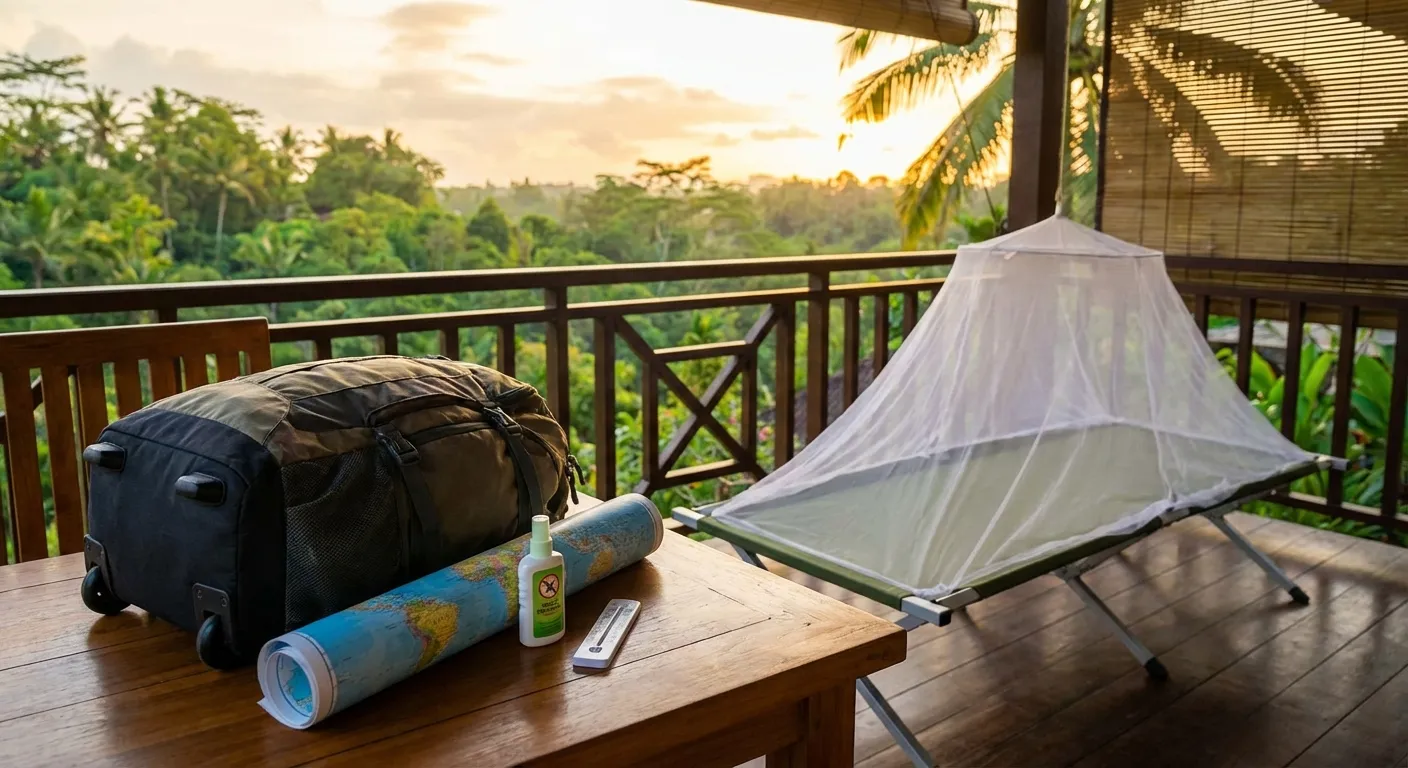
- Sleep under bed nets, ideally permethrin-treated nets in high-risk areas
- Avoid standing water near accommodation (report drainage issues to hotel)
- Use mosquito coils or vaporiser sprays in rooms if ventilation permits
Accommodation selection:
- Higher floors (mosquitoes less active above 5th floor)
- Air-conditioned rooms (consider this a health investment, not luxury)
- Screen-covered windows and doors
- Avoid ground-floor rooms near vegetation or standing water
Dengue Vaccination: The Qdenga Option
What is Qdenga?
Qdenga (TAK-003) is the first dengue vaccine approved for travellers in the UK (approved 2023). It's a live-attenuated vaccine (weakened virus) providing protection against all four dengue virus serotypes.
Effectiveness:
- First dose: Approximately 82% protection against dengue, starting 14 days after vaccination
- Two-dose series: Superior long-term protection
- Protection duration: Studies ongoing, but initial data suggests multi-year protection
Schedule:
- Standard course: Two doses, ideally 3 months apart
- Accelerated schedule: Minimum 4 weeks between doses if travel urgent
- Timeline: First dose must be given at least 14 days before travel for optimal protection
- Single dose benefit: If only one dose possible before travel, still provides 82% protection starting day 14
Eligibility and Considerations:
Licensed for: Ages 4 years and above
Recommended for:
- Travellers with previous dengue infection (seropositive): WHO recommends vaccination
- Travellers never infected with dengue (seronegative): Benefits lower than seropositive individuals; some UK advisory bodies recommend assessing individual risk versus vaccine risks
Cost: €129–€150 per dose through private travel clinics (two doses needed for full series)
Important contraindications:
- Pregnancy: Avoid during pregnancy; pregnant women should defer vaccination until postpartum
- Acute illness: Wait until recovery before vaccinating
- Immunocompromised individuals: Discuss with doctor before vaccination
Considerations for seronegative travellers (never had dengue):
- WHO generally supports vaccination given dengue burden globally
- UK advisory bodies (JCVI) express theoretical concerns about potential disease enhancement in future dengue infections
- Risk-benefit calculation: Real risk of dengue in high-transmission areas must be weighed against theoretical enhancement concerns
- For extended travel to high-dengue areas: Vaccination benefits typically outweigh theoretical risks
Booking your dengue vaccine:
- Contact travel clinics 4–8 weeks before travel for standard 3-month schedule
- If shorter timeline, explain and many clinics offer accelerated scheduling
- Combine with other travel vaccinations (hepatitis A, typhoid, etc.) at same appointments
- After completion of series, full protection maintained for future travel
Treatment: Managing Dengue at Home and in Hospital
Critical truth: There is no specific antiviral medication for dengue. Treatment entirely consists of symptom management and supportive care.
Home Management of Uncomplicated Dengue
If you develop dengue symptoms while travelling or after return:
Pain and fever management:
- Paracetamol (acetaminophen): Safe and effective for dengue fever/myalgias. Typical dosing: 500–1000 mg every 4–6 hours (max 4000 mg daily)
- Avoid NSAIDs: Do NOT use ibuprofen, aspirin, or other NSAIDs. These increase bleeding risk in dengue—use only paracetamol
- Topical measures: Cool compresses can help fever management
Fluid management:
- Aggressive hydration: Critical for dengue. Drink water, electrolyte solutions (oral rehydration salts), coconut water, or isotonic sports drinks
- Target intake: At least 1.5–2 litres of fluids daily during acute phase
- Purpose: Maintains blood volume during critical phase, reduces shock risk, supports organ function
- Monitor urine: Dark urine suggests insufficient hydration; aim for pale yellow urine
Rest:
- Your body needs energy to fight the infection
- Avoid strenuous activity
- Plan at least 1–2 weeks of limited activity
Symptom monitoring:
- Check temperature twice daily
- Monitor for warning signs (severe abdominal pain, vomiting, bleeding)
- If warning signs emerge, seek immediate medical care
Hospital Treatment of Severe Dengue
If warning signs develop, hospitalisation becomes necessary. Hospital treatment includes:
Fluid resuscitation: Intravenous fluids maintain blood volume and prevent shock from plasma leakage.
Platelet transfusions: If bleeding complications or severe thrombocytopenia develops.
Blood product support: Red blood cell transfusion if significant bleeding occurs.
Organ support: ICU care for severe organ involvement, respiratory support if needed.
Monitoring: Continuous vital sign monitoring, repeated blood tests tracking platelet trends, organ function.
Outcome: With prompt hospital intervention, >99% of severe dengue patients survive. Delayed care dramatically increases mortality.
When to Seek Medical Advice: Your Action Timeline
Urgent GP Appointment or NHS 111 Contact:
If: You've recently travelled to a dengue-endemic country and develop:
- Fever plus any of the classic dengue symptoms (retro-orbital pain, severe muscle/joint pain, rash)
- Any fever within 14 days of return from endemic areas
- Unwell symptoms after travel without specific diagnosis
Why: Early diagnosis allows appropriate monitoring, avoids inappropriate antibiotics, and enables escalation if warning signs emerge.
What to tell them: Your specific travel destination, dates, and that you're concerned about dengue exposure.
Call 999 or Go to A&E Immediately:
If: You develop ANY warning signs:
- Severe abdominal pain
- Vomiting (especially persistent or bloody)
- Bleeding from nose, gums, or in stool/vomit
- Difficulty breathing
- Severe lethargy or confusion
- Rapid or weak pulse
- Sudden drop in body temperature despite feeling unwell
If travelling: Go directly to nearest hospital emergency department. Tell staff you've recently visited a dengue-endemic country.
Special Populations: Dengue Considerations
Pregnant Travellers
Risk: Dengue during pregnancy, particularly third trimester, increases adverse outcomes for mother and fetus.
Prevention: Particularly strict mosquito avoidance essential. Consider postponing non-essential travel to high-dengue areas during pregnancy.
Vaccination: Qdenga vaccine not given during pregnancy; defer until postpartum.
Treatment if infected: Supportive care similar to non-pregnant individuals; hospital admission threshold lower due to additional fetal considerations.
Children
Risk: Young children can develop severe dengue more readily than adults.
Vaccination: Qdenga approved age 4+; discuss with travel clinic for specific recommendations.
Prevention: Enhanced mosquito protection—lightweight permethrin-treated clothing, screens on room windows, mosquito netting over cribs/beds.
Symptoms: Similar to adults but may present less specifically; higher vigilance needed.
Immunocompromised Travellers
Risk: Dengue may present atypically; more likely to develop complications.
Vaccination: Qdenga is live-attenuated vaccine—discuss carefully with your doctor. May not be suitable.
Prevention: Especially rigorous mosquito avoidance.
Recovery and Post-Dengue Considerations
Timeline to Recovery
Initial illness: Acute fever phase typically 3–7 days.
Convalescence: Fatigue and malaise often persist 1–4 weeks after fever resolves. Full recovery usually takes 2–4 weeks.
"Post-dengue syndrome": Some people experience persistent fatigue, headaches, or mild depression for weeks after recovery. This is generally self-limiting.
Immunity After Infection
Serotype-specific immunity: After dengue infection, you develop lifelong immunity to that specific serotype. However, you can still be infected by the other three serotypes.
Secondary infection risk: If subsequently infected with a different serotype, you have elevated severe dengue risk (antibody-dependent enhancement). This is why repeat travel to endemic areas carries higher risk.
Vaccination after infection: If you've had dengue, vaccination provides protection against other serotypes you haven't encountered. This is where vaccination becomes particularly valuable.
Key Takeaways
- Dengue is a real risk for travellers to tropical/subtropical regions; over 100 countries have endemic dengue
- Incubation period of 3–14 days (usually 4–7) means symptoms may emerge during or after travel
- Classic symptoms: Fever, retro-orbital pain, severe myalgias/arthralgias, rash, typically requiring bed rest
- About 1 in 20 cases progress to severe dengue, which is life-threatening without hospital treatment
- Critical phase warning: Watch for warning signs 24–48 hours after fever resolves
- No specific antiviral treatment exists; prevention and supportive care are paramount
- Prevention through mosquito avoidance (DEET repellent, protective clothing, screens) is highly effective
- Qdenga vaccine offers 82%+ protection; particularly valuable for frequent tropical travellers
- Seek urgent medical advice if you develop dengue symptoms after travel; go to A&E immediately for warning signs
- Full recovery expected with prompt treatment; >99% survive severe dengue with hospital care
Dengue doesn't have to derail your tropical travel plans. Armed with this knowledge—understanding your risk, taking prevention seriously, recognising early symptoms, and knowing when to escalate care—you can travel confidently to dengue-endemic regions while protecting your health.