Sore Throat on Holiday in Spain: Do You Need Antibiotics?
Most holiday sore throats are viral. See when Spanish guidelines call for antibiotics, why pharmacies need a receta, and how to see a doctor the same day.
Dr. Daniel Cuenca Leal
Colegiado nº 284627651 · Ilustre Colegio Oficial de Médicos de Madrid
Medically reviewed by Dr. Daniel Cuenca Leal · Updated September 27, 2026
Do You Need Antibiotics for a Sore Throat on Holiday in Spain?
Quick answer: Most holiday sore throats are viral upper-respiratory infections, and most people improve significantly within a week with or without antibiotics. Spanish primary-care guidance puts bacterial strep throat at only 5% to 15% of adult cases. If a doctor does judge your sore throat to be bacterial, you still cannot buy the antibiotic over the counter in Spain: it needs a prescription from a registered doctor.
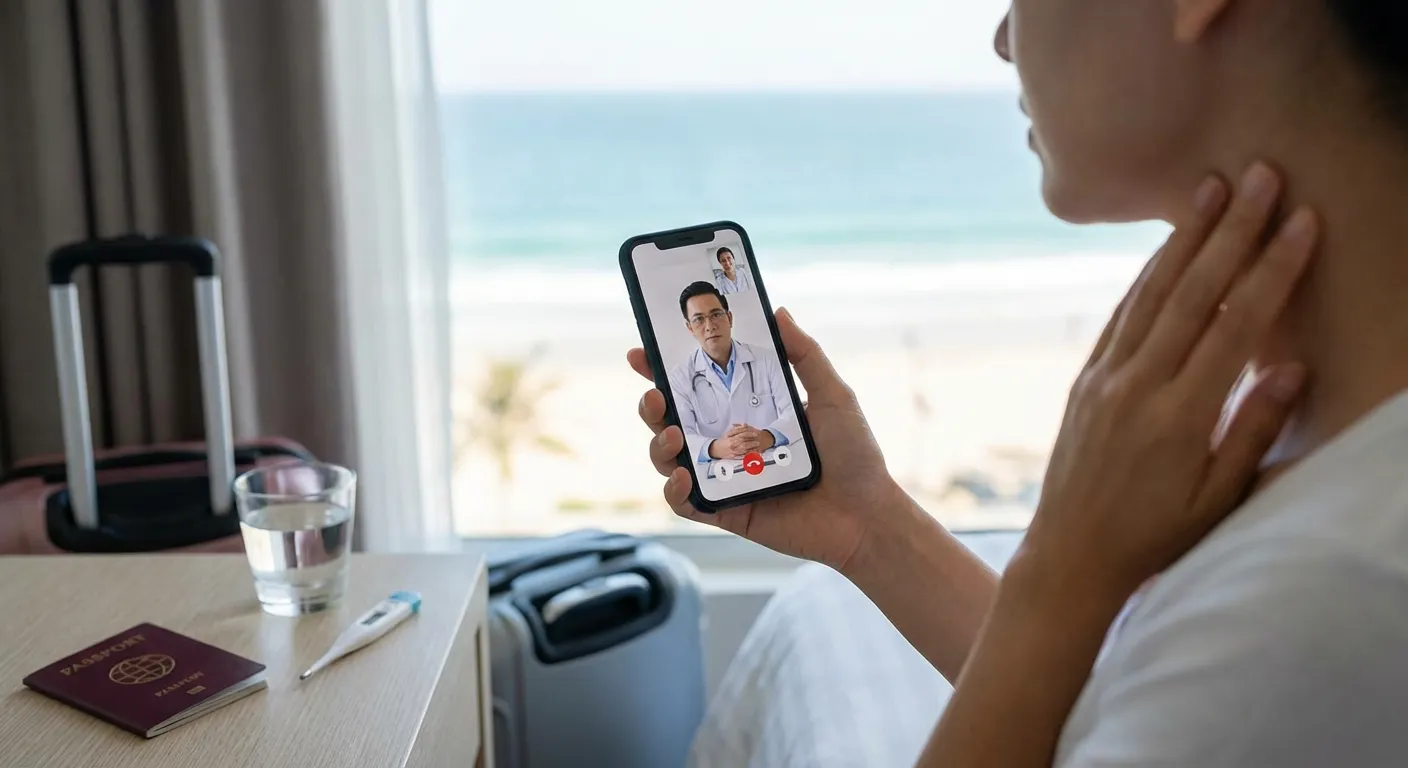
UrgentDoc connects you the same day, by video, with an English-speaking doctor registered with a Spanish medical college (médico colegiado). If the doctor judges an antibiotic clinically indicated, they issue a private electronic prescription (receta médica privada electrónica), emailed to you as a PDF that you show on your phone at the pharmacy counter. Spanish law provides that a private electronic prescription can be dispensed at any pharmacy in Spain. See how an online antibiotic prescription works.
Medical Disclaimer: The information provided in this article is for informational purposes only and does not replace professional medical advice, diagnosis, or treatment. Always seek the advice of a qualified healthcare provider with any questions you may have regarding a medical condition.
The table below compares your options for a sore throat while travelling in Spain:
| Healthcare Route | Wait | Cost | Language | Throat swab | Prescription |
|---|---|---|---|---|---|
| Public health centre (centro de salud / urgencias) | Variable; depends on triage and local demand | EHIC gives you the same rights as locally insured patients | Spanish; English not guaranteed | Can be taken in person | Public-system prescription |
| Private walk-in clinic | Variable; you travel there unwell | Out-of-pocket fee, set by each clinic | Varies by clinic | Can be taken in person | Private paper or electronic prescription |
| UrgentDoc (telemedicine) | Same day, from where you are | From €39 | English-speaking, Spanish-registered doctor | Not possible by video; clinical criteria applied | Private electronic prescription (PDF), only if clinically indicated |
The EHIC covers public-system care only: the European Commission is explicit that it does not cover private healthcare, which includes an UrgentDoc consultation.
Is Your Sore Throat on Vacation Caused by Strep or a Virus?
According to the Guía Terapéutica SACYL on acute pharyngotonsillitis, a sore throat is usually viral and part of an upper respiratory infection; nasal congestion, watery eyes, hoarseness and a cough all point towards a virus. Group A streptococcus (Streptococcus pyogenes) causes only 5% to 15% of acute sore throats in adults. Strep typically starts abruptly with high fever and chills, markedly painful or difficult swallowing, tonsillar exudate and swollen, tender glands at the front of the neck — without the cough or runny nose of a cold. The two pictures often overlap, though: white exudate can appear in viral infections too.
To weigh the probability of strep, Spanish primary care uses the Centor-McIsaac score:
- Temperature above 38°C (1 point)
- Swollen tonsils or tonsillar exudate (1 point)
- Swollen anterior neck glands (1 point)
- No cough (1 point)
- Age: 3–14 years (+1), 15–44 years (0), over 45 (−1)
With 4 or more points, the probability of strep is 51% to 53%. The SACYL guide recommends starting an antibiotic in acute tonsillitis when all four criteria are present, and also in marked systemic illness with high fever and feeling very unwell, one-sided tonsillitis (possible Vincent's angina), a history of rheumatic fever, a high risk of severe complications, or confirmed strep. The same guide warns that clinical criteria alone can lead to up to 50% of treatment decisions being wrong in either direction, and allows a delayed prescription in selected doubtful cases.
When a doctor does prescribe for probable strep, the guide's first choice is penicillin V for 10 days, with amoxicillin as the alternative; there is no evidence supporting shorter courses. Glandular fever (infectious mononucleosis) does not need antibiotics, and amoxicillin in particular tends to cause a rash in it. Symptoms should improve within 48 hours of starting treatment; if they have not improved after 48 to 72 hours, other diagnoses should be considered.
Unsure where you fall? An online sore throat assessment lets a doctor take your history and apply these criteria.
Can You Buy Antibiotics for a Sore Throat at a Spanish Pharmacy?
No. Under Real Decreto Legislativo 1/2015, Spain's medicines law, the Spanish Agency of Medicines (AEMPS) classifies every medicine as prescription-only or non-prescription when it authorises it; medicines that could be dangerous without medical supervision are prescription-only (Article 19). Dispensing a medicine without a prescription when one is required is a serious infringement (Article 111.2.b), punishable by fines of €30,001 to €90,000 (Article 114.1.b). The fine falls on the pharmacy that dispenses, not on you.
You would not be the first to ask. In a study run under Spain's National Plan against Antibiotic Resistance (PRAN) and reported in AEMPS Nota informativa 8/2018, about 20% of antibiotic requests at pharmacies were for self-medication without a prescription, and 25% of requests concerned upper respiratory infections such as pharyngotonsillitis. Pharmacists offered these patients a referral to a doctor, and 83% of those seeking self-medication accepted. As SACYL's public guidance puts it, the decision on whether antibiotics are needed belongs exclusively to doctors, and antibiotics do not work against viral infections such as colds or flu.
Dispensing status is recorded in AEMPS's CIMA medicines database. What that means at the counter:
| Medicine | Status in Spain (AEMPS CIMA) | At the pharmacy |
|---|---|---|
| Amoxicillin (incl. amoxicillin-clavulanic acid) | Prescription-only (82) or hospital use (9) | None of the 91 marketed amoxicillin medicines listed in CIMA is non-prescription |
| Ibuprofen 600 mg | Prescription-only (29) or hospital use (2) | None of the 31 marketed single-ingredient ibuprofen 600 mg medicines listed in CIMA is non-prescription |
| Ibuprofen 400 mg | Both non-prescription (sin receta) and prescription-only presentations | Available without a prescription in some presentations |
| Paracetamol 500 mg and 650 mg | Both non-prescription (sin receta) and prescription-only presentations | Available without a prescription in some presentations |
If your question is about antibiotics in Spain in general rather than a sore throat, see our guide to buying antibiotics in Tenerife, Mallorca and mainland Spain.
How Do You Get a Prescription for Strep Throat in Spain Today?
If your symptoms suggest a bacterial infection, you can see an online doctor for a sore throat from your hotel or apartment, without travelling to a clinic while unwell.
- Book a video consultation. Consultations start from €39; the final price depends on the doctor and availability. Have your passport number ready.
- Video assessment. An English-speaking, Spanish-registered doctor (médico colegiado) takes your history — fever, cough, how long you have been ill — and applies the Centor-McIsaac criteria. A throat swab cannot be taken over video.
- Prescription, only if indicated. If the doctor judges an antibiotic clinically indicated, they issue a private electronic prescription (receta médica privada electrónica) through a private e-prescription platform such as REMPe. It is emailed to you as a PDF. For most sore throats, the right outcome is no antibiotic.
- Pharmacy. Show the PDF on your phone at a farmacia. You do not need an app or a printout.
Real Decreto 1718/2010 regulates prescriptions in Spain. The rules that matter to a traveller:
| Rule | What Real Decreto 1718/2010 requires | What it means for you |
|---|---|---|
| Where it can be used | A prescription is valid throughout Spain (Art. 2.3); treatments on a private electronic prescription can be dispensed at any pharmacy in Spain (Art. 14.4) | The decree covers pharmacies anywhere in Spain, not just the region where you are staying |
| Patient identification | Full name, surnames and date of birth; on a private prescription, DNI or NIE, or for foreign nationals the passport number (Art. 3.2) | Your passport number goes on the prescription |
| Validity | Ten calendar days from the date of prescription for a first dispensing (Art. 10) | Collect your antibiotic within 10 days |
| Prescriber details | Doctor's full name, contact details, professional address including "España", qualification, número de colegiado, and an electronic signature on electronic prescriptions (Art. 3.2) | Check these appear on any prescription you are given |
| Dose and duration | Dose, frequency and total duration of treatment (Art. 3.2) | The full course is written on the prescription |
That check is worth doing: the 2018 study reported by AEMPS found that one in three private antibiotic prescriptions presented at pharmacies did not comply with this decree.
You can book an online antibiotic prescription consultation wherever you are staying — for example in Barcelona, Mallorca or Tenerife. UrgentDoc also issues a consultation invoice you can submit to your travel insurer; whether it is reimbursed depends on your policy.
What If Your Child Has a Sore Throat or Tonsillitis on Holiday?
Children are assessed differently. The Spanish paediatric consensus published in Anales de Pediatría by SEIP, SEUP, AEPap and SEPEAP concludes that in children and adolescents, clinical scores such as Centor are not sensitive or specific enough to replace a microbiological test, and should not be used on their own to start antibiotics — unless testing is unavailable or there is a risk of rheumatic fever. Without a test, even experienced clinicians misdiagnose strep throat in up to 20% to 25% of patients. When strep is confirmed, the consensus recommends penicillin for 10 days, with amoxicillin as the first alternative.
In practice, that means a child with a suspected bacterial sore throat usually needs a throat swab in person. An online paediatric consultation cannot take that swab either, but it can triage your child, advise on symptom relief, and tell you whether and where to get tested in person.
Can You Fly With Strep Throat or Tonsillitis?
Whether you are fit to fly with strep throat or tonsillitis is a clinical judgement that depends on how unwell you are. The SACYL guide notes that suppurative complications of strep throat affect 1% to 2% of patients, most often sinusitis, middle-ear infection (otitis media) and peritonsillar abscess; ear and sinus problems are the ones our guide to flying with tonsillitis and ear infections covers in detail.
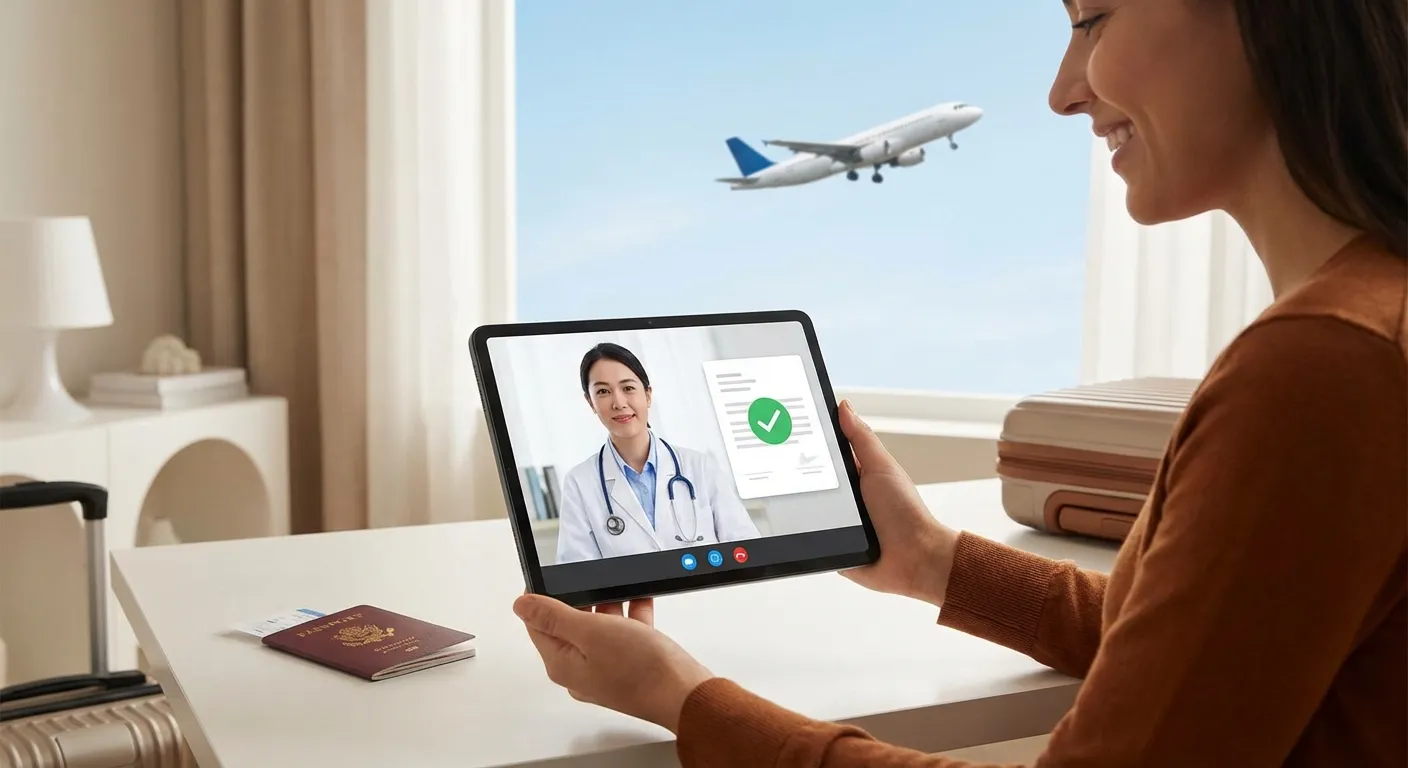
If the doctor decides during your consultation that you are not fit to travel, they can issue a dated medical certificate for your airline and travel insurer.
When Is a Sore Throat an Emergency?
The Guía Terapéutica SACYL lists the situations that need urgent hospital referral. Call 112 or go to the nearest hospital urgencias if you have:
- Signs of airway obstruction: shortness of breath (disnea), with or without noisy, high-pitched breathing (estridor).
- Inability to stay hydrated: you cannot drink enough fluid.
- One-sided tonsillitis or a suspected throat abscess: the guide lists suspected Vincent's angina (tonsillitis on one side) and peritonsillar, parapharyngeal or retropharyngeal abscess.
- Severe systemic illness: for example high fever and feeling very unwell, especially if your immune system is weakened.
Do not use an online consultation to delay assessing any of these. Separately, if you have started an antibiotic and are no better after 48 to 72 hours, get reassessed: the guide says other diagnoses should then be considered.
Frequently Asked Questions About Sore Throats While Travelling
Is my sore throat on holiday strep throat or a virus?
Most sore throats while travelling are viral and come with a cold's symptoms: cough, nasal congestion, hoarseness. Spanish primary-care guidance from SACYL puts strep at only 5% to 15% of adult cases. Strep typically starts suddenly with high fever, tender swollen neck glands and tonsillar exudate, and without a cough or runny nose.
Can I buy antibiotics for a sore throat at a Spanish pharmacy without a prescription?
No. Spanish pharmacies may not dispense a prescription-only medicine without a prescription, and none of the 91 marketed amoxicillin medicines in AEMPS's CIMA database is non-prescription. Dispensing without a required prescription is a serious infringement for the pharmacy, punishable by fines of €30,001 to €90,000 under Real Decreto Legislativo 1/2015.
Can an online doctor prescribe antibiotics for strep throat in Spain?
Yes, if the doctor judges that your symptoms meet the clinical criteria for a probable bacterial infection. A Spanish-registered doctor can then issue a private electronic prescription, which Real Decreto 1718/2010 says can be dispensed at any pharmacy in Spain. For most sore throats, the right outcome is no antibiotic.
What can I buy for a sore throat in Spain without a prescription?
Paracetamol 500 mg and 650 mg and ibuprofen 400 mg are available in non-prescription presentations at Spanish pharmacies, according to the AEMPS CIMA database. Ibuprofen 600 mg requires a prescription. Spanish guidance also recommends plenty of fluids, humidified air, saline nasal rinses and frequent hand washing.
How long does a sore throat last?
Acute pharyngotonsillitis is self-limiting, and most patients improve significantly within one week whether or not they take an antibiotic, according to the Guía Terapéutica SACYL. When an antibiotic is prescribed for strep, improvement is expected within 48 hours; no improvement after 48 to 72 hours means a doctor should reassess.
Does my EHIC cover an online doctor in Spain?
No. According to the European Commission, the EHIC gives you the same rights to healthcare as locally insured people, but only with providers in the public system; it does not cover private healthcare such as UrgentDoc. UrgentDoc provides a consultation invoice you can submit to your travel insurer.
Sore throat on holiday and want a doctor's view today? Book an online consultation with UrgentDoc and speak with an English-speaking, Spanish-registered doctor.