English-Speaking Dermatologist in Spain: How to See One
Pay for a private clinic or get a public GP referral. You can also book an online dermatology consultation with our English-speaking licensed doctors.
Dr. Daniel Cuenca Leal
Colegiado nº 284627651 · Ilustre Colegio Oficial de Médicos de Madrid
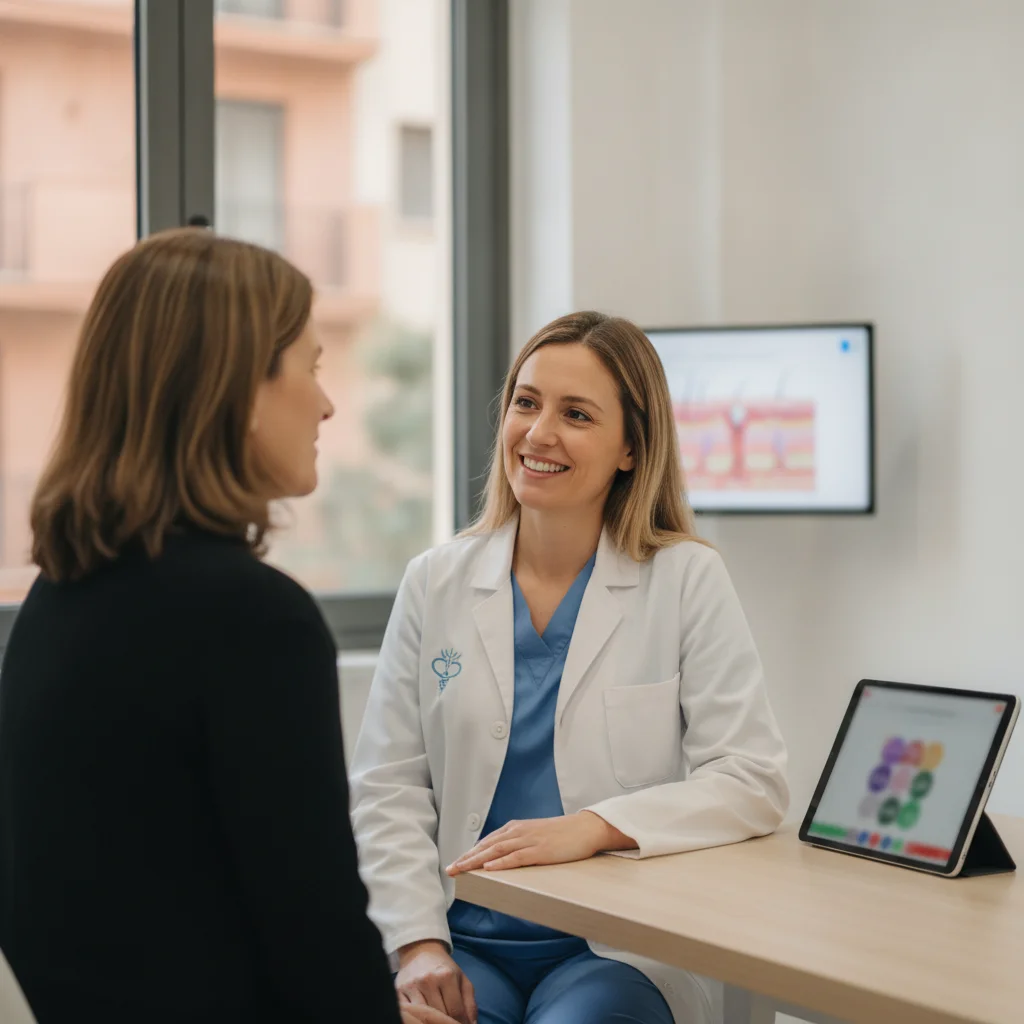
How do you see an English-speaking dermatologist in Spain?
Quick answer: To see a dermatologist in Spain, you have three main routes: the public health system, a private dermatology clinic, or an online consultation. In the public system, you need a referral from a public primary-care doctor, where waiting times average several months and language varies. Private clinics allow direct booking at your own expense without European Health Insurance Card (EHIC) or Global Health Insurance Card (GHIC) coverage. For many common skin issues, you can book an online consultation in English.
UrgentDoc provides an online dermatology consultation with an English-speaking doctor via video consultation about your skin with licensed doctors who speak English and are licensed in Spain. You do not need a referral. You submit a request, select an appointment time from those proposed by our doctors, and pay a transparent fee starting from €39, displayed before you pay. You can share photographs of your skin condition directly during the consultation. If medically appropriate, our licensed doctors can issue a private electronic prescription sent directly to your email.
Disclaimer: The information provided in this guide is for informational purposes only and does not replace professional medical advice, diagnosis, or in-person clinical examination. Always seek the advice of a qualified healthcare provider with any questions you may have regarding a medical condition or skin lesion.
The table below outlines how Spain's three main healthcare pathways compare for English-speaking visitors and expats:
| Route | How you get an appointment | Wait | What you pay | Language | Prescription |
|---|---|---|---|---|---|
| Public dermatologist (Spain's public health system) | Referral from your public primary-care doctor (Comunidad de Madrid, European Commission) | People waiting on 31 Dec 2025 had waited 127 days on average (Ministerio de Sanidad) | Free with an EHIC or UK GHIC, except prescription medicines (European Commission, GOV.UK) | Varies | Public prescription if the doctor decides |
| Private dermatology clinic | Contact the clinic | Varies | The clinic's fee; EHIC and GHIC not accepted (European Commission, GOV.UK) | Varies | Private prescription if the doctor decides |
| UrgentDoc online dermatology consultation | No referral; choose a time from our doctors' offers | You choose the time | From €39; any medicine paid at the pharmacy | English | Private e-prescription (PDF by email) if the doctor decides it is appropriate |
How do you see a dermatologist in Spain's public health system?
Accessing a specialist in the Spanish public health system requires navigating a structured, regional referral process. The European Commission's guide for EHIC holders in Spain says you need a referral from a doctor for any hospital treatment, except in an emergency (European Commission). Patients cannot book an appointment directly with a public specialist—known in Spanish as a dermatólogo—without first consulting a primary-care physician.
In Madrid, for example, you book a specialist appointment in the public system once your primary-care doctor (médico de Atención Primaria) has referred you (Comunidad de Madrid). The doctor gives you an appointment-request slip (justificante de petición de cita) and a referral form (Parte Interconsulta) to take to the specialist (Comunidad de Madrid). Once this documentation has been issued, patients in Madrid can manage their booking online, through a mobile device, at digital kiosks in select health centres, or wait for a phone call from the regional appointment management centre (Comunidad de Madrid).
Administrative identification rules are strictly defined. To book that appointment in Madrid you need your health card code (tarjeta sanitaria), your date of birth and a DNI or NIE; the booking system does not accept a passport number (Comunidad de Madrid). Furthermore, in Madrid you can then choose any of the region's public specialist centres or hospitals with open schedules (Comunidad de Madrid). Other autonomous communities maintain their own regional administrative systems and local procedures for specialist care.
How long is the wait for a dermatologist in Spain?
Public health waiting times for specialist consultations are tracked and published by Spain's Ministry of Health. On 31 December 2025, people waiting for a first dermatology appointment in Spain's public health system had been waiting 127 days on average, and 70.9% were waiting, or had been given a date, more than 60 days after their referral (Ministerio de Sanidad). Across the entire national system, there were 6.76 patients waiting per 1,000 inhabitants for dermatology (Ministerio de Sanidad).
Of the ten specialties in the Ministry of Health's report, only traumatology had a longer average wait at 132 days (Ministerio de Sanidad). The waiting times vary substantially across the country's autonomous communities.
The table below outlines the official public-system waiting figures by region from the Ministry of Health's report (Ministerio de Sanidad):
Waiting for a first public dermatology appointment, by region (31 December 2025)
| Region (cities in this guide) | Average days already waited | Share waiting more than 60 days* |
|---|---|---|
| Spain, all regions | 127 | 70.9% |
| Andalucía (Málaga, Marbella) | 233 | 72.4% |
| Canary Islands (Tenerife, Gran Canaria) | 183 | 98.2% |
| Comunitat Valenciana (Valencia, Alicante) | 103 | 58.3% |
| Catalonia (Barcelona) | 87 | 71.5% |
| Madrid region (Madrid) | 85 | 77.5% |
| Balearic Islands (Palma) | 39 | 21.8% |
This is the average time that people still on the list had already waited, counted from the day they joined it - not a forecast of how long a new referral will take. It covers first appointments in the public system only, and each region supplies its own data (Ministerio de Sanidad).
*Waiting, or given a date, more than 60 days after referral; includes people still without a date after 60 days.
The averages differ widely by region: 233 days in Andalucía (the region that includes Málaga and Marbella), 183 in the Canary Islands, 103 in the Comunitat Valenciana, 87 in Catalonia, 85 in the Madrid region and 39 in the Balearic Islands (Ministerio de Sanidad).
Can tourists use an EHIC or GHIC to see a dermatologist in Spain?
International visitors frequently rely on European agreements to access medical care while travelling in Spain. With a UK Global Health Insurance Card (GHIC) or UK-issued EHIC you can get medically necessary treatment in Spain on the same basis as a Spanish citizen, for free or at a reduced cost (GOV.UK). For holders of an EU European Health Insurance Card (EHIC), access to Spain's public health system - primary care, specialised care, hospital treatment and emergency care - is free of charge, except prescription medicines (European Commission). Under the public system, patients contribute a percentage of the cost of medicines prescribed by a public provider: 10% for pensioners from EU countries, Iceland, Liechtenstein, Norway, or Switzerland, and 50% for other cases (European Commission).
However, strict limitations apply to state-issued health cards:
- No private coverage: Neither card covers private healthcare: you pay a private clinic yourself, and the cost is not covered by your EHIC or GHIC. Some hospitals and health centres offer both private and public care, so tell them which one you want (European Commission, GOV.UK).
- Upfront payments: If you are asked to pay upfront, you are not being treated in the public system and your EHIC is not being accepted (European Commission).
- No medical tourism: A GHIC or EHIC cannot be used for non-urgent planned treatment - that is, travelling to Spain in order to have treatment (GOV.UK).
- Referral obligations: The European Commission's guide for EHIC holders in Spain says you need a referral from a doctor for any hospital treatment, except in an emergency (European Commission).
Because the EHIC and GHIC do not cover private healthcare, you pay for an online consultation with UrgentDoc yourself (European Commission, GOV.UK).
Can you find an English-speaking dermatologist in Marbella, Málaga, Barcelona, Palma, Valencia or Madrid?
Whether staying along the Costa del Sol, holidaying in the Balearic Islands, or visiting major cities, finding healthcare in English depends on your location and chosen pathway. In the public system, the average days already waited for a first dermatology consultation were 233 days in Andalucía (covering Málaga and Marbella), 183 in the Canary Islands (including Tenerife and Gran Canaria), 103 in the Comunitat Valenciana (including Valencia and Alicante), 87 in Catalonia (including Barcelona), 85 in the Madrid region, and 39 in the Balearic Islands (including Palma) (Ministerio de Sanidad).
English language availability in public health centres and private clinics varies. If you opt for a local private dermatology clinic, you pay the clinic's fee yourself, as the EHIC and GHIC do not cover private healthcare (European Commission, GOV.UK).
Alternatively, our doctors see you by video wherever you are staying in Spain - for example in Marbella, Málaga, Barcelona, Palma, Valencia, Madrid or the Canary Islands. A video consultation about your skin allows you to discuss symptoms directly in English without travelling to a physical clinic.
What can an online dermatology consultation do from photos and video?
Teledermatology provides remote evaluation for a wide range of dermatological concerns. Spain's dermatology academy, the AEDV, said in 2018 that teledermatology complements in-person dermatology: it can help with triage, prioritisation and referral, but it is never a substitute for an in-person consultation with a dermatologist when one is needed (AEDV). Furthermore, the AEDV notes that every form of teledermatology - photos sent for later review, live video, or a mix - has strengths and weaknesses, and that the method should fit the skin problem (AEDV).
During an online dermatology consultation with an English-speaking doctor, our doctors evaluate your skin via real-time video and submitted photos. The doctor asks about your symptoms, medical history, current medicines, and allergies, and decides what is clinically appropriate: medical advice, a prescription, or an in-person clinical examination. A diagnosis, a prescription, or a clinical result is never guaranteed; every course of action remains the doctor's clinical decision.
Our licensed doctors evaluate common dermatological concerns remotely, providing clinical guidance such as acne treatment online, eczema treatment online, and care to get a rash checked online.
To understand what can and cannot be handled virtually, review the comparison below:
Online or in person?
| What you need | Online consultation with UrgentDoc | In-person dermatologist |
|---|---|---|
| A doctor to look at a rash, acne or eczema | Yes, by video and photos | Yes |
| A prescription, if the doctor decides it is appropriate | Yes - private e-prescription, PDF by email | Yes |
| Help deciding whether you need to be seen in person | Yes | - |
| Dermoscopy of a mole | No | Yes (Fundación Piel Sana) |
| Removal or biopsy for a definitive diagnosis | No | Yes (Fundación Piel Sana) |
| Regular dermoscopy checks for many moles | No | Yes (Fundación Piel Sana) |
If the doctor decides a medicine is appropriate, you receive a private electronic prescription as a PDF by email, issued through a private e-prescription platform such as REMPe. Show the PDF at a pharmacy; the pharmacist checks it before dispensing it.
You pay two things: the consultation fee, from €39 and shown before you pay, and the pharmacy's price for any medicine.
Our doctors cannot put you on a public waiting list, give you a public referral or shorten a public wait; a public referral comes from your public primary-care doctor. Our doctors also cannot perform physical procedures, such as dermoscopy, biopsies, or surgical mole removal.
What to have ready for your video consultation:
- Good lighting and clear photos of the skin problem taken beforehand.
- A complete list of current medicines and skincare products you use.
- Known allergies and relevant medical history.
- Your passport, DNI, or NIE number, which must appear on the prescription.
Can a mole be checked online?
Evaluating moles requires caution and strict diagnostic boundaries. The AEDV's patient foundation says moles can grow, multiply or darken with sun exposure, puberty or pregnancy, but that a mole that changes should be checked by a dermatologist (Fundación Piel Sana).
Its warning signs are the ABCDE - Asymmetry, irregular Borders, uneven Colour, a Diameter over 6 mm and Elevation of part of the surface - plus fast growth, itching, pain or bleeding, and a mole that looks very different from your others (the 'ugly duckling' sign). These signs are only a guide; a doctor has to assess them (Fundación Piel Sana).
Specific population groups carry higher clinical risks:
- People with fair skin and light eyes, red hair, skin that burns easily, relatives with skin cancer or melanoma, or a lot of time in the sun need to see a dermatologist often to have their moles checked (Fundación Piel Sana).
- For people with many moles, the AEDV's patient foundation recommends regular follow-up with dermoscopy by a dermatologist (Fundación Piel Sana).
Dermoscopy is a quick, harmless examination with a special lit microscope placed directly on the skin. It helps tell benign from malignant skin lesions, and the AEDV's patient foundation calls it essential in a dermatological examination (Fundación Piel Sana). Furthermore, only removing a mole, or taking a biopsy, and examining it under a microscope gives a definitive diagnosis (Fundación Piel Sana).
So a changing mole needs an in-person examination by a dermatologist. An online consultation can help you decide how to get it seen, but it cannot replace that examination and cannot rule out skin cancer (AEDV, Fundación Piel Sana).
When should you see a doctor in person or call 112?
Certain skin symptoms and acute medical situations require immediate, in-person attention rather than a remote consultation.
A mole or spot that changes, shows any ABCDE sign (Asymmetry, irregular Borders, uneven Colour, Diameter over 6 mm, Elevation), grows fast, itches, hurts or bleeds, or looks very different from your other moles: have it examined in person by a dermatologist (Fundación Piel Sana). Dermoscopy needs an in-person visit (Fundación Piel Sana), only removal or a biopsy gives a definitive diagnosis (Fundación Piel Sana), and teledermatology never replaces an in-person consultation when one is needed (AEDV). If our doctor thinks your skin needs an in-person examination, they will tell you so.
In a life-threatening emergency, call 112 - do not book a video consultation and do not wait for a public or private appointment.
Call 112 in any situation where a life may be in danger. Spanish public health guidance gives, for example: traffic or work accidents; suspected stroke; difficulty breathing; chest pain; poisoning; loss of consciousness; major bleeding; severe burns; a severe allergic reaction (Junta de Castilla y León).
On the call, follow the instructions you are given and do not hang up until you are told to (Junta de Castilla y León).
Frequently Asked Questions
How do I find an English-speaking dermatologist in Spain?
You can access care through three routes: the public health system, which requires a referral from a public primary-care doctor (Comunidad de Madrid, European Commission); a local private clinic, which you pay yourself and where language availability varies (European Commission, GOV.UK); or an online dermatology consultation with our licensed, English-speaking doctors from €39 without needing a referral.
Do I need a referral to see a dermatologist in Spain?
In the public system, yes. The European Commission's guide for EHIC holders in Spain says you need a referral from a doctor for any hospital treatment, except in an emergency (European Commission), and in Madrid, for example, your primary-care doctor must issue an appointment request and referral slip before booking (Comunidad de Madrid). In contrast, no referral is needed for an online consultation with UrgentDoc.
How long is the wait for a dermatologist in Spain?
On 31 December 2025, people waiting for a first dermatology appointment in Spain's public health system had been waiting 127 days on average, and 70.9% were waiting, or had been given a date, more than 60 days after their referral (Ministerio de Sanidad). This measures the average time people still on the list had already waited since joining it, not a forecast for a new referral (Ministerio de Sanidad). Regional averages ranged from 39 days in the Balearic Islands to 233 days in Andalucía (Ministerio de Sanidad).
Can I use my EHIC or GHIC to see a dermatologist in Spain?
An EHIC or UK GHIC provides access to medically necessary public care on the same terms as Spanish citizens, but hospital treatment requires a public doctor's referral (European Commission, GOV.UK). Neither card covers private healthcare, meaning you pay private clinics yourself (European Commission, GOV.UK). Because the EHIC and GHIC do not cover private healthcare, you pay for an online consultation with UrgentDoc yourself (European Commission, GOV.UK).
Is there an English-speaking dermatologist in Marbella?
Our licensed doctors speak English and can see you by video wherever you are staying in Marbella. In the public system for Andalucía, people waiting on 31 December 2025 had already waited an average of 233 days for a first dermatology appointment (Ministerio de Sanidad). However, if you have a changing mole, it needs an in-person examination by a dermatologist (AEDV, Fundación Piel Sana).
Can an online doctor check a mole from a photo?
An online consultation cannot replace an in-person examination or rule out skin cancer (AEDV, Fundación Piel Sana). While teledermatology can assist with triage and referral, a changing mole requires an in-person assessment using dermoscopy, which involves placing a specialized lit microscope directly on the skin (AEDV, Fundación Piel Sana).
Can an online doctor prescribe skin treatment in Spain?
A doctor decides whether a medicine is clinically appropriate during the video consultation, and a prescription is never guaranteed. If the doctor decides a medicine is appropriate, you receive a private electronic prescription as a PDF by email, issued through a private e-prescription platform such as REMPe. Show the PDF at a pharmacy; the pharmacist checks it before dispensing it.
Need to speak to a doctor about a rash, eczema flare, or acne? Book an online consultation with an English-speaking licensed doctor in Spain today.